FOX News : Health

Showing posts with label Khmer Rouge. Show all posts

11 July, 2019

The revolution will be televised

Marc Eberle
July 9, 2019
 

From our print archive: Movie producer and real estate mogul Oum Prum looks back at his past life as a filmmaker for the Khmer Rouge regime

Editor’s note: When we think of the Khmer Rouge, we don’t normally think of a roomful of technicians feverishly cutting clips together in a Phnom Penh film lab. But for Oum Prum, one of the men recruited by the regime to film the brutal rebirth of Cambodia under Pol Pot’s forces, this was the lens through which he viewed the darkest chapter in the Kingdom’s past. His memories of filming the fall of Phnom Penh and the Khmer Rouge’s bloody efforts to rebuild a shattered Cambodia shine new light on a regime desperate not just to craft a new nation, but a new people inspired by acts of wordless self-sacrifice – regardless of the human cost. Now, for the first time, you can read his story online. 

OP leans back on his sofa in his Phnom Penh studio. “I was eight years old when I held my first gun, nine when I held my first camera,” he says. OP is short for Oum Prum, the name the Khmer Rouge gave him. Oum means “powerful” and Prum is the four-headed god that smiles from the towers of Cambodia’s most enigmatic temples.

Procedural Deadlock Leaves Future of Khmer Rouge Tribunal in Doubt


Almost 13 years and $300 million after it was established, the U.N.-backed tribunal prosecuting Khmer Rouge atrocities has less than a year remaining in its mandate and uncertain prospects of bringing anyone else to trial.
Since it was sworn in on July 2006, the hybrid Cambodian and international court has managed to convict torture center chief Comrade Duch' in 2010 and bring in guilty verdicts against Khmer Rouge leaders Nuon Chea and

Khieu Samphan in 2018. All three were sentenced to life imprisonment for crimes against humanity, war crimes, and genocide, torture, and murder.

20 April, 2010

Year Zero

April 17, 2010 By Peter Wilson
Source: American Thinker

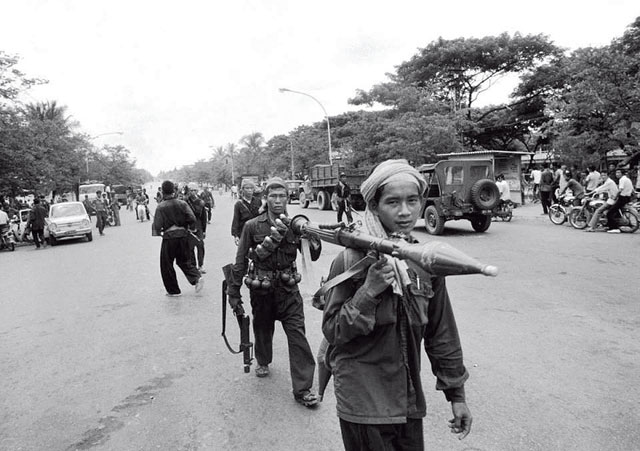
The Khmer Rouge declared revolutionary Year Zero thirty-five years ago today, on April 17, 1975, the day Communist guerrillas in black pajamas and truck-tire sandals marched victoriously through the streets of Phnom Penh. An indication of the regime's brutality came within 24 hours, when the Khmer Rouge ordered the two million residents of Phnom Penh, including hospital patients, to evacuate the city.

Their reign of three years and eight months left Cambodia devastated, with the better part of an entire generation -- approximately 1.7 million Cambodians out of a population of 7.9 million -- annihilated by bullet, axe, shovel blow to the back of the head, plastic bag suffocation, unspeakable torture, or by starvation caused by ruinous economic policies.

The Pol Pot clique set out to create history's most pure form of Communism in a single bound, striving to surpass even Mao's disastrous Great Leap Forward. Their success was Cambodia's failure. Despite the legacy of another horror-filled Marxist experiment, the lessons of the Khmer Rouge remain shrouded in equivocation and myth.

Myth #1: Despite the example of the Khmer Rouge, Marxism remains a valid political philosophy.

Marxist sympathizers like columnist James Carroll still argue in polite society that "Marxism has yet to be really tried." It's just that by strange happenstance, Communist governments have always been subverted by corrupt, brutal men.

Corruption and brutality, however, are not incidental to Communism; they are part of its essence.

In order to redistribute wealth, the State must assign power to fallible humans. Our democracy has checks and balances that constrain (we hope) those who hold power. The Khmer Rouge leaders wielded absolute power, which corrupted absolutely, with predictable tragic consequences.

Every time it has been tried, Marxism leads to the charnel house, turning subject countries into giant concentration camps, each a "vast Belsen," as Robert Conquest described Stalin's Soviet Union. Pol Pot, Mao, Stalin, Lenin, Ho Chi Minh, Castro, Che Guevara, Abimael Guzman, Mengistu, and Kim Jong-il are among history's most accomplished butchers. To argue that the Communist ideology that motivated them is incidental to their crimes devalues the deaths of the hundred million murdered by Communism in the 20th century.

Myth #2: The Khmer Rouge were not really Communists.

Like the Viet Cong, they were "rice paddy nationalists." Or freedom-fighters gone wrong battling French and American imperialism. Or Asian Nazis. Or some perverted Buddhist agrarian sect.

Evidence to the contrary is not difficult to find. As students in Paris, Pol Pot and Ieng Sary (Brothers Number One and Number Two) joined the Cercle Marxiste, where they imbibed Marx and Rousseau. To point out the obvious, Pol Pot and Ieng Sary named their army the "Red Khmer," red being the color of Communism. They were funded by Beijing, Moscow, and Hanoi. Theirs was closer to a Maoist interpretation of Marxism than to Stalin's urban Communism with its Five-Year Plans, fetishizing steel mills and cement factories. Khmer Rouge terror techniques were drawn from Stalin and Mao: the brutality, the destruction of the family, the abolition of religion, the terror famines, and the internal purging that George Orwell described so accurately three decades earlier in the terrifying scenes of Napoleon forcing confessions in Animal Farm.

Myth #3: Nixon's secret bombing of Cambodia was responsible for the Khmer Rouge victory.

Blaming America for the Khmer Rouge began early on in William Shawcross's Sideshow: Kissinger, Nixon, and the Destruction of Cambodia (1979). Roland Joffe's 1984 movie The Killing Fields disseminated the narrative of American guilt to an entire generation, one that is repeated in many American history textbooks.

According to data released by the Clinton administration and reported by Ben Kiernan and Taylor Owen, from 1969 to 1973, American B-52s dropped "2,756,941 tons' worth [of explosives] in 230,516 sorties on 113,716 sites," more than was dropped by all parties in World War II. Innocent Cambodian villagers were surely killed, although estimates vary wildly, from 5,000 to 600,000.

Nevertheless, despite the rage of the antiwar movement, the tin soldiers, Nixon's coming, and four dead in Ohio, the bombing was not entirely unjustified.

The bombing proceeded in two distinct phases, each with different objectives. President Nixon's Operation Menu began in March 1969, striking at North Vietnamese sanctuaries where the NVA delivered food and arms to supply depots less than one hundred miles from Saigon, protected by Cambodia's neutrality under the Geneva Convention. Although Prince Sihanouk agreed to the passage of NVA supplies coming down the Ho Chi Minh Trail and through the Port of Sihanoukville, evidence shows that he grew fed up with North Vietnamese intrusions into his country and gave Nixon a green light to bomb NVA military targets.

In the second phase, as the Vietnam War was winding down, American bombing continued at the request of the Lon Nol government to slow the advance of the Khmer Rouge.

History may judge Nixon and Kissinger harshly for the humanitarian costs of the bombing. It appears that the bombing assisted Khmer Rouge recruitment efforts, but overall, it delayed the Khmer Rouge takeover. Keep in mind the simple facts that Communist countries backed the Khmer Rouge with arms, materiel, money, and ideology, while the U.S. supported the pro-western Lon Nol government in an attempt to defeat the Khmer Rouge and stop the spread of Communism. As Peter Rodman writes in a 1981 American Spectator article on Sideshow: "By no stretch of moral logic can the crimes of mass murder be ascribed to those who struggled to prevent their coming into power."

Myth #4: "American ruthlessness turned Communists into totalitarian fanatics." [Via historian Philip Windsor, quoted by Noam Chomsky and Bernard Herman in Manufacturing Consent (1988).]

In addition to bearing responsibility for bringing Pol Pot to power, the American bombing is also guilty of pushing the Khmer Rouge over the edge into insanity. Nixon and Kissinger are therefore guilty of war crimes, with the blood of 1.7 million Cambodians on their hands.

This myth is an international relations version of the "society made me do it" defense for the brutal criminal, akin to blaming mass murder on police brutality. It transforms the Khmer Rouge from aggressors to helpless victims reacting to aggression.

The theory that violence generates violent retaliation may make sense on a psychological level, but it is implausible that the Khmer Rouge's "auto-genocide" -- the systematic campaign of destruction of their own people -- was motivated by desire for revenge against Americans. During the Khmer Rouge reign from 1975-79, Cambodia was isolated from the outside world; the last American bomb fell in August 1973.

Historical examples also contradict this theory: The ruthless Nazi blitzkrieg did not transform Londoners into totalitarian fanatics.

This myth did, however, alleviate the antiwar Left of any responsibility it might have felt for pressuring Congress to withdraw the financial support for South Vietnam promised in the Paris Peace Talks, which certainly played a role in southeast Asian dominoes falling in 1975: Cambodia on April 17, South Vietnam on April 30, and Laos on November 28.

*

Today, the Khmer Rouge has few enthusiastic defenders. In Jean-François Revel's wry phrase, "One of the most richly enrolled clubs on the planet is the Enemies of Past Genocides." But it is not enough to condemn the Khmer Rouge; we must condemn the Marxist ideology that motivated them.

Peter Wilson has a large extended family of Khmer Rouge survivors and has worked on children's television in Cambodia. His blog is walkingdogcapitalist.

22 January, 2010

Lost in Cambodia

guardian.com.uk
* Andrew Anthony
* The Observer, Sunday 10 January 2010


Why did a radical British professor become a cheer-leader for Pol Pot? And why was he murdered on the very day he'd met the brutal dictator? Andrew Anthony on the extraordinary life and death of Malcolm Caldwell


The name of Malcolm Caldwell is remembered now by very few people: some friends, family, colleagues, and students of utopian folly. In the 1970s, though, Caldwell was a major figure in protest politics. He was chair of CND for two years, a leading voice in the anti-Vietnam war campaign, a regular contributor to Peace News, and a stalwart supporter of liberation movements in the developing world. He spoke at meetings all over the country, wrote books and articles, and engaged in public spats with such celebrated opponents as Bernard Levin.

The name of Kaing Guek Eav is, arguably, known by even fewer people, at least outside of Cambodia. Instead it is by his revolutionary pseudonym "Duch" that Kaing is usually referred to in the press. Duch is the only man ever to stand trial in a UN-sanctioned court for the mass murder perpetrated by the Cambodian communist party, or the Khmer Rouge, in the late 1970s. His trial on charges of crimes against humanity, grave breaches of the Geneva Conventions, and homicide and torture concerning thousands of victims, drew to a close in November. Justice has taken more than 30 years, but a verdict and sentence are expected sometime in the next few weeks.

Although their paths crossed only incidentally, the two men shared two main interests. They both had a pedagogic background: Caldwell was a history lecturer at the School of Oriental and African Studies (SOAS), University of London, while Duch, like many senior Khmer Rouge cadres, started out as a schoolteacher. And they both maintained an unbending belief in Saloth Sar, the leader of the Khmer Rouge revolution, who went under the Orwellian party title of Brother Number One, but was known more infamously to the world as Pol Pot. It was an ideological commitment that would shape the fate of both men and they held on to it right up until the moment of death – in Caldwell's case, his own, for Duch, the many thousands whose slaughter he organised.

In each circumstance, the question that reverberates down the years, growing louder rather than dimmer, is: why? Why were they in thrall to a system based on mass extermination? It's estimated that around two million Cambodians, more than a quarter of the population, lost their lives during the four catastrophic years of Khmer Rouge rule. What could have led these two individuals, worlds apart, to embrace a regime that has persuasive claim, in a viciously competitive field, to be the most monstrous of the 20th century?

When Caldwell appeared at SOAS for an interview in the late 1950s, the senior faculty thought that they had landed one of the academic stars of the future. Caldwell, who took his PhD at Nottingham University, had gained a reputation as a bright young talent and, according to college legend, he presented himself as a sober scholar.

"So they hired him," recalls Merle Ricklefs, a former SOAS colleague and now a history professor at the National University of Singapore. "Then he showed up for lectures and suddenly he was this Scottish radical with long hair, looking unkempt, and they felt as though they'd been betrayed.

"I thought he was actually a very good economic historian," says Ricklefs, who remembers "an extraordinary character… very ideologically committed". He was also struck by his warmth and good manners. As a young American, who dressed in conservative fashion, arriving in England during the height of the Vietnam war, Ricklefs expected to be greeted with a certain amount of antipathy, but he found Caldwell to be "always cordial. Always looking slightly dishevelled and revolutionary, but never the slightest hint of discourtesy."

The picture of a friendly, if rather unconventional character, is confirmed by others who knew him. Professor Ian Brown was Caldwell's successor at SOAS and he was also his former student. "He was well liked – I suspect not by the SOAS hierarchy," says Brown, "but certainly loved by students and colleagues."

He describes a "skinny, somewhat emaciated, rather scruffy character who, bizarrely, always used to wear a suit – though it was clearly a suit that had been bought in the 1950s equivalent of Oxfam and not seen too many dry cleaners." Caldwell never hid his politics from his students, indeed he made a point of proselytising to them. One of his protégés was Walter Easey, who, according to Easey's obituarist, Caldwell converted to "a fierce and angry communism". But to Professor Brown, "he was a gentle person, quietly spoken, and very tolerant of opposing views. He treated everyone well. He was very encouraging and a really inspiring teacher."

Both Brown and Ricklefs use the same word to describe this well-travelled, extremely well-read and highly intelligent man: naive. SOAS, says Brown, was a college whose standing and ethos rested upon sound empirical study. "Everyone else in the history department went off every summer to the archives in Rangoon, Baghdad, etc, and got deep inside the data. Malcolm didn't. He was a man with very clear theoretical and ideological views and the empirical basis didn't seem to worry him hugely."

It's not that Caldwell was lost in bookish abstraction, for he did visit the various communist regimes he extolled. It was more that when he got there he was all too willing to accept state propaganda as verified fact. For example, he praised the "magnitude of the economic achievements" of Kim Il-Sung's impoverished North Korea and, returning from a trip to the highly secretive state, he wrote that the country was "an astonishing tribute not only to the energy, initiative and creativeness of the Korean people, but also to the essential correctness of the Juche line". "Juche" was the mixture of ultra-nationalism and self-reliance on which Kim built his monumental personality cult. About the totalitarian surveillance and ruthless political repression, Caldwell said nothing.

Although academic traditionalists may have disapproved of Caldwell's slanted scholarship, many idealistic students were inspired by his lectures. Tariq Ali, who became famous as a 1968 student leader, recalls going to see him talk on southeast Asia when Ali was at Oxford. They soon got to know each other and in the summer of 1965 went to a peace conference together in Helsinki. "We had to fly to Moscow," says Ali, "then there was a train, via Leningrad as it was then, to Helsinki. We talked a lot and became very friendly. It was later on that his Cambodian deviation was a bit off-putting. And he could never completely explain it."

At one time, the pair discussed opening a Vietnamese restaurant as a sort of act of antiwar gastro-prop. "He would say that after a few drams," Ali recalls. "He was a great whisky drinker. He was also a great cricket fan and an early Scottish nationalist."

Cricket is mostly followed in Scotland by the upper classes, but Ali got the impression that his old friend came from a middle-class background. His Wikipedia entry states that he was the son of a miner. "You know," says Ali, "we never bothered about these things. We were so totally immersed in politics and the state of the world, we never really talked about each other, our personal lives or social backgrounds."

In seeking to understand why this idealistic Scotsman became a cheerleader for Pol Pot, it would be wrong to consign him to the maverick margins. A member of the Labour Party, he stood as a candidate in the 1977 local elections in Bexley. John Cox, who followed in Caldwell's footsteps as chair of CND, is adamant that there was nothing out of the ordinary about his predecessor's politics. "He was well in the mainstream of what I would call generally progressive liberal thinking," says Cox.

This idea that support for the most illiberal systems of government is all part of the liberal tradition is one of the more bemusing aspects of progressive politics. But the missing factor in the equation is the view that the United States of America is the ultimate villain. The background to the brutality visited on Cambodia was the brutality visited on Vietnam by US forces.

Although the Vietnam war was more complex than is often acknowledged (the tensions between North and South, for example, long predated the war), the Americans essentially inherited France's colonial conflict. But they fought it in the context of the Cold War. As much as US administrations may have seen the battle as one between communism and the free world, to the majority of Vietnamese it was a liberation struggle.

In an effort to close down North Vietnamese supply lines to the South, the US also launched a devastating bombing campaign on neighbouring Cambodia. Instead of winning the war in the former, it served only to destabilise the latter. To make matters worse, an American-supported coup put in place the corrupt government of Lon Nol in Phnom Penh. So there was a tendency among many anti-war protesters to see the Khmer Rouge as just another national liberation movement, fighting to escape from under the American yoke.

One man who observed the truth up close, four years before the Khmer Rouge came to power, was a French ethnologist called François Bizot. In 1971, while out researching Buddhist practices, he was captured in the Cambodian countryside by Khmer Rouge insurgents. He was held captive with scores of Cambodian prisoners at the M-13 prison camp, a precursor to the 196 santebal (secret police) offices that were set up after the Khmer Rouge seized power. The head of the camp, and the Frenchman's tireless interrogator, was Duch.

Bizot wrote about the encounter in a remarkable memoir called The Gate. After three months, during which he was shackled and repeatedly accused of being an American spy, he was suddenly released – all the other prisoners were executed. So relieved was the Frenchman that he asked Duch if he would like a gift. His jailer thought for a while and then replied, "with the look of a child writing to Father Christmas, 'The complete collection of Das Kapital by Marx.'"

Three days before Christmas in 1978, Malcolm Caldwell received an early present. On the final day of a two-week tour of Cambodia, he was told that he would meet Pol Pot. This was indeed a rare privilege. Unlike most other communist leaders, Pol had not created a personality cult. There were no posters of him. He was seldom seen or quoted. Many Cambodians had not even heard of him. Only seven westerners were ever invited to what had been renamed Democratic Kampuchea. And Caldwell was the first and only Briton.

There were several reasons why Caldwell had been received in Phnom Penh. He was on good terms with China, Cambodia's main ally in the region. There were also growing tensions between Cambodia and its larger neighbour Vietnam and, fearful of an invasion, Pol Pot was belatedly attempting to improve Kampuchea's image abroad. Most of all, while other supporters had wavered, Caldwell had remained steadfast. Only months before, he had written an article in the Guardian, rubbishing reports of a Khmer Rouge genocide. He cited Hu Nim, the Kampuchean Information Minister, who blamed the deaths on America. Caldwell was unaware that Hu had himself already been tortured to death in one of Pol Pot's execution centres. Such killings that the Khmer Rouge had committed, argued the peace activist, were of "arch-Quislings who well knew what their fate would be were they to linger in Kampuchea".

Travelling with Caldwell were two American journalists, Elizabeth Becker and Richard Dudman. Becker had been a foreign reporter in Phnom Penh during the civil war that brought the Khmer Rouge to power. She knew the terrain, and had been to Thailand to talk to refugees. She and Caldwell argued endlessly about the true nature of the situation.

"He didn't want to know about problems with the Khmer Rouge," she says. "And that carried over to not wanting to know about problems between Cambodia and Vietnam. He was stuck in '68 or something."

Yet for all their disagreements, she liked Caldwell. "He was a lovely man, very funny, very charming," she says. "A real sweetie. He was also very homesick for his family and he said he'd never spend another Christmas away from them."

According to Becker, Caldwell had not read François Ponchaud's Cambodia: Year Zero, the book that first catalogued the Khmer Rouge genocide. A friend of François Bizot, Ponchaud was a Catholic missionary who was in Phnom Penh when the victorious Khmer Rouge army marched into town. His book became required reading for anyone interested in what was happening in Cambodia. "The fact that Malcolm, a professor, had not read it before he went, that I couldn't believe," says Becker. "I think it was almost ideological that he didn't read it."

It's perhaps not that strange that Caldwell had neglected to read Ponchaud, given that he had already dismissed the Frenchman's credibility in print. He based his damning opinion on a brief extract of Year Zero which the Guardian had published and a critique of the book by the American academic, Noam Chomsky. An icon of radical dissent who continues to command a fanatical following, Chomsky had questioned the legitimacy of refugee testimony that provided much of Ponchaud's research. Chomsky believed that their stories were exaggerations or fabrications, designed for a western media involved in a "vast and unprecedented propaganda campaign" against the Khmer Rouge government, "including systematic distortion of the truth".

He compared Ponchaud's work unfavourably with another book, Cambodia: Starvation and Revolution, written by George Hildebrand and Gareth Porter, which cravenly rehashed the Khmer Rouge's most outlandish lies to produce a picture of a kind of radical bucolic idyll. At the same time Chomsky excoriated a book entitled Murder of A Gentle Land, by two Reader's Digest writers, John Barron and Anthony Paul, which was a flawed but nonetheless accurate documentation of the genocide taking place.

We can never know if Caldwell would have taken Ponchaud more seriously had Chomsky not been so sceptical, but it's reasonable to surmise that the Scotsman, who greatly admired Chomsky, was reassured by the American's contempt. In any case, the 47-year-old Caldwell arrived in Cambodia untroubled by the story that Ponchaud and others had to tell. In fact, he had just completed a book himself that would be posthumously published as Kampuchea: A Rationale for a Rural Policy, in which he wrote that the Khmer Rouge revolution "opens vistas of hope not only for the people of Cambodia but also for the peoples of all other poor third world countries".

With Dudman and Becker, Caldwell was escorted around the country to a series of staged scenes. Alarmed by the changes she saw and frustrated by what she was not allowed to see, Becker grew increasingly combative with her hosts. "It was so clearly awful," says Becker. "One of the problems was the absence of what I saw. The absence of people. And that's a different kind of proof to 'I don't see any people being executed.'"

Caldwell was not unduly bothered. "He preferred to stay in the car and laugh at the clumsy photo opportunities prepared for us," Becker wrote in her book on Cambodia, When The War Was Over.

"He'd travelled to other communist countries," she tells me now, "and he knew exactly what the PR routine was and he thought that all governments do PR. He did not know Cambodia, and he didn't speak the language. If you don't speak the language, don't know the country, you can edit out a little more easily."

At the end of the tour, the party returned to Phnom Penh, which Dudman described as "a Hiroshima without the destruction, a Pompeii without the ashes". They stayed at a guest house near the centre of Monivong Boulevard, one of the empty city's main thoroughfares. Close by was the secret facility of Tuol Sleng, a former school that had been turned into an interrogation centre. Known as S-21, Tuol Sleng specialised in gaining confessions through torture. Between 14,000 and 16,000 prisoners – men, women and, most hauntingly, children – passed through its gates, including Hu Nim. Only seven survived. It was run by Duch.

Nowadays Tuol Sleng is a genocide museum, and an established part of the southeast Asian tourist trail. Although they were intent on erasing history, Pol Pot and his senior cadres were obsessed with the accomplishments of the 12th-century Hindu dynasty that built the temple complex of Angkor Wat and constructed elaborate dam and irrigation systems. They considered their own contribution to Khmer culture to be of a similar, if not greater, significance. It speaks eloquently of the Khmer Rouge's achievements that, while Angkor Wat remains the country's main tourist attraction, the next most popular sights for visitors are Tuol Sleng and the Killing Fields at Choeung Ek, where the prisoners from S-21 were taken to be "smashed" – usually with an ox-cart axle. A ghost town under the Khmer Rouge, Phnom Penh is now a bustling, sprawling city, dense with people and commercial activity. In May 1975, one month after the Khmer Rouge evacuated the capital, the Swedish author Per Olov Enquist wrote: "The brothel has been emptied and the clean-up is in progress. Only pimps can regret what is happening."

If that was blatant wishful thinking, it's an unpalatable truth that the pimps have returned. A potent mix of Developing World poverty, cheap flights and sexual licence has made Cambodia a magnet for sex tourists and paedophiles. The upmarket hotels around the riverside are full of western and Japanese businessmen, and a certain kind of furtive middle-aged traveller, stubble-chinned and plump-stomached, is a conspicuous presence in the bars and clubs frequented by young and under-age prostitutes.

Cambodia has just two seasons: wet and dry. It either rains or it doesn't, a binary climate that may have helped shape the Khmer Rouge Manichean view of the world – revolutionary or counter-revolutionary, insider or outsider, good or bad. It was the dry season when I visited in late November, and a cooling wind blew through the hot, polluted streets. At first sight, Tuol Sleng's large courtyard, lined with coconut palms, provides welcome respite from the noise beyond. A respectful silence is maintained by visitors, including groups of western backpackers, with their cameras and guidebook glaze. The three-storey buildings have been left pretty much as they were abandoned in 1979, slightly dilapidated with jerry-built cells, barbed-wire fences and medieval instruments of torture. The effect is to transport the visitor not just back in time, but also into the reptilian depths of the imagination, a merciless place of zero compassion.

In the courtyard of the prison is a poster listing the rules of the camp. None of them makes for pleasant reading. For example, number 2 states in an imperfect translation: "Don't try to hide the facts by making pretexts this and that. You are strictly prohibited to contest me." It vividly articulates the mentality that shaped S-21, and indeed Kampuchea beyond, the relentless determination to remove every option from the prisoner – and citizen – to reduce them to absolute compliance. But perhaps the most disturbing is number 6: "While getting lashes or electrification you must not cry out at all." Denied every human and judicial right, the inmates were also refused the one prerogative of the tortured: the right to express pain.

I visited the archive on the second floor of the building, where some of the 4,000 files the Vietnamese discovered are housed. Here, I was brought the "confession" of John Dewhirst, a 26-year-old teacher from Newcastle who was captured in 1978, while sailing with friends through the Gulf of Thailand. Intercepted by a Khmer Rouge patrol boat, they were placed in S-21 and tortured over the course of a month. As the weeks passed, Dewhirst made a series of ever more bleakly surreal confessions. They start out as straightforward biography – he explains that he had studied at Loughborough University. Then he admits to being a CIA agent, recruited at Loughborough where the CIA, he is made to say, maintains one of its covert training bases. It "was housed in a building disguised as the Loughborough Town Council Highways Department Surveyor's Office". He also reveals that his father is another CIA agent, using the cover of "headmaster of Benton Road secondary school". Dewhirst was murdered by the Khmer Rouge in 1978.

S-21 was not concerned with the truth. Its only aim was to derive the fullest possible confession in accordance with party requirements. In his book Voices From S-21, the historian David Chandler quotes Milan Kundera's phrase (used to describe the Soviet bloc secret police) of "punishment seeking the crime" to sum up the prison's project. To this end, the most depraved techniques – electric shocks, rape, the forced eating of excrement, medical experimentation, flaying, and lethal blood extraction – were employed. It's hard to comprehend that these agonies were not just formalities, they were preliminaries. It wasn't a question, on arriving at the prison, that an inmate would be lucky to get out alive. He or she would be lucky to get out just dead. A guidebook for interrogators clarified the issue: "The enemies can't escape from torture; the only difference is whether they receive a little or a lot."

The precise level of punishment was decided upon by Duch. If the confession was not sufficiently elaborate, the punishment was increased. In these situations Duch impressed upon his staff that "kindness is misplaced". Some interrogators were more disposed to brutality than others. And some were simply demented sadists. The most sadistic of them all went by the name of Toy, a pitch-black irony that his English-speaking victims were in no position to appreciate. In recent testimony, a prison guard recalled that one of Dewhirst's party (either the young teacher himself or the New Zealander or Canadian travelling with him) was burned alive in the street. The order that they be incinerated came directly from Pol Pot.

Just a few months after that grisly murder, Caldwell prepared himself to meet the man who commissioned it. The Scotsman knew little or nothing of Dewhirst's fate. Instead his mind was on agrarian revolution. Caldwell believed that the world was accelerating towards a global famine and that the answer was Developing World self-sufficiency. But Cambodia was a strange place to test his theory. As Professor Ian Brown notes: "This is a part of the world that historically had not been a food-deficient area, so you wouldn't go looking for a crisis there. Again, that seems to indicate a more fundamental flaw in his approach: he comes at it with a theoretical position. And therefore he'd search for an argument, not necessarily evidence, that will sustain that."

In Pol Pot, Caldwell found someone with an argument that suited his purposes. Pol's plan was a massive increase in rice production to finance Cambodia's reconstruction. It required collectivisation and slave labour, though Caldwell preferred to see the effort in terms of spontaneous revolutionary spirit. In the event, owing to the shortage of technicians and experts (who were killed as class enemies) and lack of peasant support, production fell well short of targets. But terrified of underperforming, regional commanders still sent their designated contribution to be exported. The result was the opposite of self-sufficiency: famine. Unable to accept the shortcomings in his plans, Pol instead blamed spies and counter-revolutionaries, and that meant that, in the absence of rice, spies and counter revolutionaries had to be produced. The network of torture camps was the only area of Democratic Kampuchea's infrastructure that met its targets.

Of these dreadful facts, Caldwell remained ignorant on the Friday morning in Phnom Penh that he was taken in a Mercedes limousine to see Pol Pot. The setting for the meeting was the former Governor's Palace on the waterfront, built during the French colonial period. In a grand reception room replete with fans and billowing white curtains, the two men sat down and discussed revolutionary economic theory.

Becker had met Pol Pot earlier the same day, and in When the War Was Over she writes: "He was actually elegant, with a pleasing face, not handsome but attractive. His features were delicate and alert and his smile nearly endearing."

The perennially shabby academic and the fastidious dictator must have made for an odd couple. In any case, Caldwell left the meeting a happy man. He returned to the guest house he was sharing with Becker and Dudman, full of praise for Pol Pot and his political outlook. "We went over stuff," says Becker. "He thought he had had a good conversation. He had avoided at all costs any discussion of Vietnam. And he was looking forward to going home."

That night they all had dinner together and afterwards Dudman went to his room. Becker and Caldwell "stayed at the table to have our last argument about Cambodia". He took the longer view and said that the revolution deserved support. She, on the contrary, was even more convinced of the refugees' testimonies. "That night," she writes, "Caldwell tried once more to get me to change my mind."

Becker went to bed at 11pm and was woken a few hours later by the sound of what she took to be dustbins. Coming to her senses, she realised there were no dustbins in Phnom Penh. What she had heard was gunfire. She opened her bedroom door to see a young man pointing a pistol at her. He was wearing two bands of ammunition and carrying an automatic rifle over his shoulder. She begged him not to shoot and locked herself in her bathroom.

Meanwhile Dudman had woken up and, looking out of his window, saw a file of men running along the street. He knocked on Caldwell's door. The two men spoke briefly and then a heavily armed man approached. The man shot at the floor and Dudman ran into his room. Two shots were fired through his door. The two Americans remained hiding in their rooms for the next hour before an aide arrived and told Becker to stay where she was. Almost another hour passed before she was allowed to come out. Caldwell, she was told, had been shot. He was dead.

The Extraordinary Chambers in the Courts of Cambodia (ECCC) are located in a large, purpose-built court on the dusty outskirts of Phnom Penh. During the course of last year, hundreds of Cambodians made the trip out from the city and in from the countryside to bear witness to a long-overdue reckoning.

The lone defendant in the trial is a slim, well-preserved 67-year-old with small, sensitive eyes. With his thick grey hair and concentrated expression, he looks like a sprightly grandfather, a little stiff and formal, but sufficiently attuned to the contemporary world as to be smartly dressed in a Ralph Lauren shirt or, on another occasion, a cream cashmere roll-neck sweater. A giant bullet-proof glass screen divides the court from the auditorium, where 500 or more people sit watching the proceedings. Centre stage is Duch (pronounced "Doik" in Khmer), seated with his back to the audience. To his left is a bank of lawyers, and behind them in the corner the relatives of victims. In front of the defendant sit the judges, on an imposing two-tier stand. Ten years, some 400 staff, a dozen judges, a battery of international lawyers, an ongoing legal wrangle, and many millions of pounds is what it has taken to put Duch on trial.

Following Caldwell's murder, four guards assigned to the tourist's protection team were arrested and taken to S-21. Owing to the importance of their alleged crime, the commandant of the prison was instructed to head their interrogation. So the stories of Caldwell and Duch came together at the inevitable point of a torture camp. Here, amid bestial squalor, is where the liberation dream ended.

Two of the "confessions" made by guards referred to in their S-21 files as "the Contemptible Met" and "the Contemptible Chhaan", outline a baroque conspiracy involving many other people. The Contemptible Chhaan gives an explanation for the murder: "First, we were attacking to ruin the Party's policy, to prevent the Party from gathering friends in the world… And in attacking the guests on this occasion, we would not attack them all. It would be enough to attack the English guest, because the English guest had written in support of our Party and the Kampuchean people for a long period of time already… Therefore, we must absolutely succeed in attacking this English guest, in order that the American guests would write about it."

Whether this was yet another example of innocent men implicating other innocent men, it's impossible to know. Certainly there must have been some kind of in-house involvement, as the guests were guarded. But who instructed the guards, and why they did so, remains a subject of speculation. Some argue that the Vietnamese were behind the killing, others that it was a function of an internal party struggle.

Caldwell's brother, David, wrote a letter to the Guardian, expressing his belief that "Mal" had "discovered the truth about the Pol Pot regime" but "dared not admit this to either Becker or Dudman". This seems unlikely. David Chandler told me that he once met the translator of the meeting between Caldwell and Pol Pot, who remembered a very pleasant exchange conducted in a spirit of enthusiastic agreement. If that anecdote suggests Caldwell died a dedicated Pol Potist, it tells us little about Pol, a man for whom the word "inscrutable" might have been invented. As his deputy, Ieng Sary, later recalled: "Pol Pot, even when he was very angry, you could never tell. His face… his face was always smooth. He never used bad language. You could not tell from his face what he was feeling. Many people misunderstood that – he would smile his unruffled smile, and then they would be taken away and executed."

But why would he seek international support by killing one of his few remaining friends from abroad? It makes no sense. "Don't apply rational thinking to the situation," Becker cautions. "It was crazy. Crazy. Malcolm's murder was no less rational than the tens of thousands of other murders." The journalist Wilfred Burchett claimed to have seen a Cambodian report not long after Caldwell's death, which stated that he "was murdered by members of the National Security Force personnel on the instructions of the Pol Pot government". Burchett theorised that Caldwell had changed his mind about the regime, but all the available evidence indicates otherwise. In the end, Becker's conclusion seems to be the most satisfactory: "Malcolm Caldwell's death was caused by the madness of the regime he openly admired."

The confessions of Caldwell's alleged killers were completed on 5 January 1979. Either that day or the following one, the four men were bayoneted to death in the prison itself. They were very possibly the last killings to take place at S-21. On 7 January, the Vietnamese army arrived in Phnom Penh, and Pol Pot and his associates fled into the jungle.

The contrast between the care taken to observe Duch's legal and human rights and the indifference with which he dispatched his victims is lost on no one. But as Philippe Canonne, one of the lawyers representing the relatives of the victims, said of the urge to inflict on Duch what he had meted out to his prisoners: "We must give voice to this sentiment, but then have the strength to transcend it."

It's this sort of resolution that has made the trial a legal landmark in a nation that has had little experience of the rule of law. That it was ever staged at all is a major accomplishment. For 20 years after the Vietnamese invasion, Duch lived at liberty. At first he followed the bulk of the Khmer Rouge into exile on the border with Thailand. After the fall of the Khmer Rouge, the US and China refused to accept the Vietnamese puppet government installed in Phnom Penh. In a shameful version of the principle that my enemy's enemy is my friend, they instead persuaded the UN to recognise a coalition resistance movement, of which the Khmer Rouge formed the major player. Thus Pol Pot was afforded the support of China, the protection of Thailand, and the indirect recognition of the United States.

For two decades the Khmer Rouge waged guerrilla warfare against the government in Phnom Penh. Then, in 1997, Pol Pot was placed under house arrest by his fellow Khmers Rouges. He died peacefully in his sleep on 15 April 1998. A year later the photojournalist Nic Dunlop found Duch working for a Christian relief agency. An interview was duly published and Duch handed himself in to the Phnom Penh authorities.

In theory, the trial is a joint effort between the UN and Cambodia, but the effort has been all the UN's. The Cambodian People's Party, which has ruled since Pol Pot was overthrown, is led by onetime Khmer Rouge members who, under threat of purging, had defected to Vietnam. One of these is Hun Sen, a former revolutionary soldier, who has been prime minister since 1985. His government was accused by Amnesty International of widespread torture of political prisoners, using "electric shock, hot irons and near suffocation with plastic bags". And for many years, senior former members of Pol Pot's government lived under protection in Cambodia, some with family links to the government. So there were several reasons why a major trial with international media coverage was potentially embarrassing or inconvenient.

After much pressure, in November 2007 the Cambodians finally arrested the four most senior surviving Khmer Rouge leaders: Nuon Chea, Ieng Sary, Ieng Thirith and Khieu Samphan. Their trial is scheduled to start in 2011, though few observers will be surprised if it is indefinitely delayed. All of them claim ignorance of any wrong-doing. Perhaps the most galling example is a long letter of evasion and self-justification that Khieu Samphan, Pol Pot's chief ideologue, wrote to Cambodian newspapers in 2001. "I do not see any importance in bringing up this tragic past. We would be better off to let everyone be at peace so that all of us can carry on our daily tasks… I tried my best for the sake of our nation's survival, so that we might enjoy development and prosperity like other nations. I am so surprised that this turned out to be mass murder."

In one form or another, this exculpation has been used over and again by the supporters of communist revolutions, from the Russian via the Chinese through to the Cambodian. Each new manifestation commanded the fervent advocacy of a new generation of radicals. Sooner or later the grim reality was revealed, which, paradoxically, only raised the hope that the next version would get it right. As the French philosopher Jean-François Revel has remarked: "Utopia is not under the slightest obligation to produce results: its sole function is to allow its devotees to condemn what exists in the name of what does not."

Somehow the link between Marxist-Leninist ideology and communist terror has never been firmly established in the way, for instance, that we understand Nazi ideology to have led inexorably to Auschwitz. As if to illustrate the point, earlier last year the ECCC announced that Helen Jarvis, its chief of public affairs, was to become head of the victims unit, responsible for dealing with the survivors, and relatives of the dead, of S-21.

Jarvis is an Australian academic with a longterm interest in the region, who was recently awarded Cambodian citizenship. She is also a member of the Leninist Party Faction in Australia. In 2006 she signed a party letter that included this passage: "We too are Marxists and believe that 'the ends justify the means'. But for the means to be justifiable, the ends must also be held to account. In time of revolution and civil war, the most extreme measures will sometimes become necessary and justified. Against the bourgeoisie and their state agencies we don't respect their laws and their fake moral principles."

Jarvis refused to speak to me about these matters. But Knut Rosandhaug, the UN's deputy administrator for the tribunal, said that the administration "fully supports" her. In this sense, although she was never a Pol Potist herself, Jarvis shows that the spirit of Malcolm Caldwell has survived the last century. It lives on in the conviction that the ends justify the means, and in the manner that liberal institutions can house the most illiberal outlooks.

The means, of course, always become the ends. Duch or someone like him is the method and the madness, the process and the final product. At least the man himself claims to grasp what continues to elude too many who should by now know better. In his deposition to the court, he said: "I clearly understand that any theory or ideology which mentions love for the people in a class-based concept is definitely driving us into endless tragedy and misery."

The following day, his lawyer, Kar Savuth, asked that Duch be acquitted and set free.

Caldwell didn't trouble himself with the means in Cambodia. He was too focused on an imaginary end, which meant that he never glimpsed the deadly real one approaching.

"He may have been starry eyed," says John Cox. "But we all do that. Even my local football team I support long after they've been destroyed match after match. It's a human failing."

A few days after Caldwell's murder, a testimonial was published in the Guardian.

"Caldwell," the writer said, "was an irreplaceable teacher and comrade whose work will undoubtedly suffer the customary fate of being better appreciated after his death."

As it turned out, history has forgotten Caldwell. But the amiable apologist for tyranny should be remembered, if only so that we don't forget history.★
10 December, 2009

From killing fields to US candidate

The Phnom Penh Post
Monday, 07 December 2009 15:02 James O'Toole

Sam Meas, the first Cambodian-American to seek congressional office, talks about growing up in war-torn Cambodia, his move to the US and his outlook on the Kingdom’s political situation.

Sam Meas, a 36-year-old investment analyst from Haverhill, Massachusetts, is a Republican candidate for the United States congress in Massachusetts’ 5th District. He is the first Cambodian-American to run for Congress, or any other state or federal office in US history. Sam Meas and a cousin crossed the border from Cambodia into Thailand’s Khao-I-Dang refugee camp in 1983. He came to the US to live with a foster family in 1986, and went on to graduate from Virginia Tech University in 1996. Sam Meas recently took time out from working and campaigning to conduct an email interview with the Post.

What were the most striking things about the United States for you when you arrived in 1986?
Our flight arrived in New York City at night from Europe. The view of the city from the plane was the most incredible sight I have ever laid my eyes on. Bright lights were lighting up the city grids from the ground. I thought it was heaven on earth.

The second striking feature was the highway system. A group of us took the taxi from the airport to the hotel. We were driven through underpasses, overpasses and underground tunnels. I was just mesmerised by the wonder of it all. The tall buildings and modernity of everything in America were just incredible. I had never seen any of these things before in my life.

Last but not least, I was pleasantly surprised by the kind and welcoming people in America. True to their reputation, Americans are kind, compassionate and caring people.

What are your memories of life in Cambodia under the Khmer Rouge?
I was very young when the Khmer Rouge took Kandal province; It has since been relayed to me that I was just 2 years old at the time. My father was arrested and never to be seen again, meaning that he, like so many other thousands of teachers and intellectuals, was executed....

My older brothers and sisters were drafted to be part of the Khmer Rouge’s new Army of Labour and sent to work far away. I never saw much of them after they left.... While my mother was putting in 12-hour days for Angka in the field, my brother and I spent our time between our mud hut and the day care centre at the communal kitchen. One of our jobs, besides fending for ourselves, was collecting cow manure....

I did witness individual murders and mass killing. My family was spared, I was told, solely because the local Khmer Rouge village chief attested that our family was part of the “liberated people” or “old people”.

What are your thoughts on the current state of politics in Cambodia?
Cambodia, like many other countries that are recovering from years of protracted civil war, is lacking much and needs rebuilding on so many fronts – the economy, education, healthcare, social justice, respect for the rule of law, respect for private property, human rights, independence of the judicial system and transparency and accountability at all levels of government – all at the same time.

Has some progress been made? The answer is yes. Can more be done and at a faster pace? Absolutely. Would the economy of Cambodia greatly benefit from an independent judicial system and greater respect for private property? I believe so.

On September 10, the US congress heard testimony from Cambodian witnesses who detailed a litany of human rights abuses allegedly perpetrated by the Cambodian government, with Sam Rainsy Party parliamentarian Mu Sochua claiming that Cambodian democracy is experiencing “an alarming free fall”. Do you find these testimonies credible?

This is all the more reason why there is an urgent need for an independent and transparent judicial system in Cambodia – so that any allegations, as well as lawsuits and countersuits, can be brought forward in the Cambodian courts. Only in an independent Cambodian court can the truth be found by a Khmer judge and the Khmer people. As a US congressman, I will fight to right these injustices.

Many Cambodians who grew up in America find themselves back in Cambodia after being deported for committing felonies as noncitizens. What is your position on this issue?
While I am strongly sympathetic to their plight, everyone must obey the law. So, I first strongly advise all legal immigrants to apply for US citizenship as soon as they are eligible.... Many of these deportees who grew up in the US came with their parents when they were very young and had ample time to apply for US citizenship. In a free society, one must be held responsible for one’s actions. They committed the felonies and aggravated felonies or drug trafficking, and are therefore responsible for their actions.

However, as an elected official, I would also like to examine the different agreements signed between the US and Cambodia, Vietnam and Laos.... It seems that there is variation in the agreements between the US and these countries.…Why is it that noncitizens from these countries are treated differently? The same crime must have the same punishment regardless of the perpetrator’s race or country of origin.

Have you been following the progress of the Khmer Rouge tribunal? If so, what are your thoughts on it and the role it is attempting to play in national reconciliation?
I have been following the Khmer Rouge tribunal. I think what needs to happen in order for the healing to begin is to model the tribunal on the truth commissions in South Africa. Those who committed the heinous crimes need to openly confess on record to the people and ask forgiveness from the victims and their families. No retribution or punishment.

What role does Buddhism play in your outlook on politics?
I am a Buddhist and believe in the teachings of our Lord Buddha. One needs to have compassion for human suffering. But each human being is held accountable and responsible for our actions. Therefore, there is a certain limited role of government in our daily lives. Each of us is responsible in ensuring that our government works for us.

Government should create a limited safety net for its citizens, but government should not be there to provide a handout and to take care of every need of its citizens. Citizens create and get the type of government they choose. Dictatorship and totalitarianism did not happen overnight. Be wary of a government that promises and gives too much, for that beneficence ultimately comes from what it takes from the people.

INTERVIEW BY JAMES O’TOOLE

29 April, 2009

The Trouble With the 'Genocide' Label

The Trouble With the 'Genocide' Label

The Current Discussion: Today is "Genocide Remembrance Day "in the Armenian community, a particularly strained time of year for Turkey and Armenia. What's a realistic first step forward toward reconciliation for each of these countries?

By Salil Tripathi

Turkey and Armenia have begun the slow, tentative waltz of rebuilding relations, after President Obama spoke in Istanbul, but did not use the G-word.

That was perhaps a wise decision, notwithstanding the strong emotive reason that propelled many to call a spade a spade, a machete a machete, and a genocide a genocide, leading to the Congressional Resolution. The truth is that ultimately only communities themselves can make the decision to leave the past behind. International leaders - even one as gifted as Barack Obama - can only play a limited role. (Sudan's conflict didn't stop when Colin Powell called the killings in Darfur a genocide, and few countries joined him in condemning the Sudanese leadership.)


This is a peculiar period in the world annals of our coming to terms with genocide. Cambodia is trying to account for genocide and killing fields by indicting Kaing Guek Eav, also known as Duch. India's ruling party withdrew a candidate for Parliament, partially in response to a shoe-throwing incident. (Credible human rights groups allege that the candidate was involved in the 1984 Sikh massacre, after two Sikh bodyguards assassinated former Prime Minister Indira Gandhi.) Tamils in Britain accuse the Sri Lankan army of committing genocide in Sri Lanka. Bangladesh's newly-elected government sets its sights on bringing to justice those accountable for the Pakistani Army's widespread killings of Bangladeshis in 1971.

And then there is Rwanda. This month is the 15th anniversary of the Rwandan genocide. In a recent issue of Paris Review, the French writer Jean Hatzfeld recalls the uneasy aftermath of dealing with released prisoners who had at one time massacred a community's loved ones. Hatzfeld's books - The Machete Season (2005), Life Laid Bare (2007), and The Antelope's Strategy (2009) -- are required reading for anyone who wants to understand the psyche of the perpetrator and the victim, of what makes a killer, and, as Hannah Arendt observed in the context of Eichmann, the banality of evil.

The fixation with the word 'genocide' comes from its emotive power. Among human rights abuses, genocide is arguably the worst, which is why governments fight tooth and nail to prevent others from calling their heinous acts as genocidal. The definition, developed after we discovered the horrors of Auschwitz and Buchenwald, is written bearing in mind the Nazi atrocities against the Jewish community. Those abuses made every preceding abuse seem less significant. With the definition was so precisely drafted, what were we to call Stalin's purges - or even Pol Pot's bloody rule - where a single ethnic group wasn't targeted, and where the masterminds of those genocides did not always get around to implementing policies that would prevent future generations from being born? These were mass killings, massacres, crimes against humanity. But they weren't quite like the Holocaust - just as the Holocaust wasn't quite like what happened in Cambodia between 1975 and 1979.

Genocide and Crimes Against Humanity are extremely powerful terms, which is why governments resent such characterization. The sad consequence is that diplomats then perform the delicate dance of defining the term more precisely, and argue whether a particularly horrendous abuse was genocide. Lost, amidst all this, are human impulses - of ethics, morality, revenge, justice, redemption, and compassion.

What happened in Turkey nearly a century ago - as indeed in Rwanda, Cambodia, Sri Lanka, Bangladesh, and Sudan - must never happen again. And yet Obama and other world leaders can only nudge governments to do the right thing. Ultimately communities and nations must develop the confidence and face the past, apologize where necessary, and forgive as appropriate. That requires a moral core, not legalism alone. The law helps and is of course necessary. But genocide is wrong not because the law says so, but because it is against our conscience.

02 April, 2009

Move Sought for Admitted Torturer


Move Sought for Admitted Torturer
2009-04-01
Cambodia’s international tribunal for top Khmer Rouge officials hears arguments over whether to move the one defendant who has voiced remorse to a site away from the others.


AFP

Francois Roux (L front), French co-defense lawyer for Kaing Guek Eav, better known as Duch (R behind), April 1, 2009.

PHNOM PENH— The lawyer for the Khmer Rouge's chief torturer said his client should be held separately from fellow defendants at the international tribunal here after he apologized for atrocities committed by the Marxist faction during its rule in the 1970s.

Kaing Guek Eav—better known as Duch—commanded the 1975-79 regime's main S-21 prison, also known as Tuol Sleng, where as many as 16,000 men, women, and children are believed to have been brutalized before being sent to their deaths.

His French lawyer, Francois Roux, told the court on Wednesday that Duch should be freed from the genocide tribunal's special jail where he is now held with four other Khmer Rouge defendants whom he may implicate in crimes during his testimony, and sent to a "safe house."

Roux said Duch's rights have been violated by his 10-year detention without trial. Cambodian law prohibits "provisional detention" longer than three years, he said.

"Detention for 10 years is no longer provisional detention," Roux said.

Co-prosecutor Chea Leang argued against the request, saying Duch should remain where he is for his own safety.

The tribunal is considering the request.

Remorse

Duch is charged with war crimes and crimes against humanity as well as murder and torture and could face a maximum penalty of life in prison. Cambodia has no death penalty.

He is the only defendant among five to express remorse, but he has said he was afraid to challenge orders from higher up.

The tribunal marks the first bid to assign legal responsibility for the deaths of an estimated 2 million Cambodians from starvation, medical neglect, overwork, and execution under the 1975-79 rule of the Khmer Rouge, whose top leader, Pol Pot, died in 1998.

On Monday, Duch appeared unflinching as the indictment was read out in court, including allegations that prisoners were beaten, electrocuted, smothered with plastic bags or had water poured into their noses, and that children were taken from parents and dropped to their deaths or that some prisoners were bled to death.

Original reporting by RFA's Khmer service. Additional reporting by the Associated Press. Service director: Sos Kem. Executive producer: Susan Lavery. Edited in English by Sarah Jackson-Han.

KRT: How far down the chain of command should the prosecutions go?

Khmer Rouge & Cambodia

Noam Chomsky interviewed by George McLeod
April 01, 2009 By Noam Chomsky
Source: The Phnom Penh Post

Noam Chomsky's ZSpace Page

Join ZSpace

March27, 2009 -- Top Khmer Rouge (KR) leaders are going on trial in Cambodia. You have some history with Cambodia and have written extensively on the KR. Do you believe a United Nations trial is the best way forward, or should it be left to the Cambodian people?

I think it should be left to the Cambodian people. I can't imagine a UN, international trial. But then it shouldn't be limited to the Cambodians - after all, an international trial that doesn't take into account Henry Kissinger or the other authors of the American bombing and the support of the KR after they were kicked out of the country - that's just a farce - especially with what we now know about the bombing of Cambodia since the release of the Kissinger-Nixon tapes, and the release of declassified documents during the Clinton years. There has been a very different picture of the scale and intensity of the bombing and the genocidal scale of it. For an international trial to omit this would be scandalous.


How far down the chain of command should the prosecutions go?

I think that's a decision for Cambodians to make - the questions should be: should [the prosecutions] be limited to KR criminals, or should it include criminals from the Lon Nol regime, or later, but those are decisions the Cambodian need to make.

You can make a case for an internationally-run trial, but as I said, it would be absolutely farcical if it was restricted to Cambodians.

The records say that the US wanted to "use anything that flies against anything that moves" [during the bombing of Cambodia] , which led to five times the bombing that was reported before, greater than all bombing in all theatres of WWII, which helped create the Khmer Rouge.


So to try to excuse their crimes from the broader picture may be sensible for Cambodians who are trying to find some internal justice and reconciliation, but for the broader picture, it's simply farcical.


So you think US leaders should be tried in connection with the crimes of the DK regime?

Not just in the context of the DK regime—that's afterwards, I think supporting the KR after the Democratic Kampuchea regime, after they were kicked out - or supporting the Chinese invasion to punish Vietnam for the crime of driving them out, that's a crime in itself. But the much worse crime was by Kissinger-Nixon, and its pretty hard to disagree with analysts like Ben Kiernan ... who released the documentation during the Clinton years - their conclusion was that this bombing, which really had genocidal intent -anything that flies against anything that moves - essentially changed the KR from a small group into a mass army of what they call enraged peasants bent on revenge. How could you omit that when you are discussing the Khmer Rouge atrocities?


Are you saying the KRT is a show trial?

These trials altogether have a very strange character - the most serious of all the tribunals since WWII was the Nuremberg trials, and that was a well-designed, carefully executed legal proceeding.

But if you look at it closely, it was a farce - that was implicitly conceded to allow the Nazi war criminals to be tried. They were some of the worst monsters in history - and there is no doubt they were guilty - they had to define a notion of war crime, and it was post-facto - they were being tried for crimes after they committed them.

The trial had a very clear definition of war crime - it was crimes that you committed, and that [the allies] didn't.

So for example, the bombing of urban centers was not considered a crime and the reason is very explicit - the allies did more of it than the Germans.

The bombing of Japan frankly leveled the country and was not considered a crime because [the allies] did it. In fact, German war criminals were able to exonerate themselves if their defense was able to demonstrate that their counterparts in the West did the same thing.

For example, a German submarine admiral who did commit war crimes by normal standards was freed from those charges when he brought into evidence testimony from an admiral in the British and American navy saying ‘yeah that's what we did too'. This was recognized, and chief prosecutor Jackson, he made a very eloquent speech to the tribunal where he said we were handing the defendants here a poisoned chalice, and if we sip from it, we must suffer the same punishment or else the trial is meaningless.

Well, we have sipped from that chalice numerous times since - the chief crime was the crime of aggression - the supreme international crime, and count the times the US and Britain have been guilty of outright aggression. Have they been tried?

It's a farce - victor's justice - and if you run through the rest of the trials, they pretty much have the same properties. In fact, I can't think of one that has been honest in this respect - the only ones I can think that have been honest are the Truth and Reconciliation Commissions like in South Africa, El Salvador or Guatemala, where they brought out what happened and identified the perpetrators. And in many cases, it was done very honestly, and by the victims - they're the ones that testified.


Then why are the KR on trial and not other murderous political leaders? Some Israeli generals for example have been accused of crimes against humanity as well.

An Israeli general would never be tried because they are backed by the US. These things reflect power systems. Very often the people that are tried deserve to be tried and sentenced, but the structure of the trials has exonerated the powerful.

In fact the position is extreme - the US is the most powerful country in the world and it's also the most extreme in rejecting any form of judicial control - the US is the only country that rejected a World Court decision that rejected the unlawful use of force. And that's why an Israeli general can't be tried - if an Israeli was brought to the Hague, the US might invoke Europeans call The Netherlands Invasion Act. The US has legislation authorizing the President to use force to rescue any American brought to the Hague.


So you're saying that this trial is not about justice?

There is an element that it's about justice ... You take Nuremberg again; there is no doubt that the accused were guilty - but is it justice? You take the foreign minister Ribbentraup - one of the crimes for which he was sentenced, was that he supported a pre-emptive strike against Norway. Well, at a time Norway was a threat to Nazi Germany of course, and he ordered a pre-emptive strike. But what did Colin Power do? Iraq was no threat.


You were heavily criticized for some of your views of the KR, and some accused you of being favorable to the KR. Were you unfairly criticized?

It's ridiculous - in fact, there has been a massive critique of some of things that Edward Herman and I wrote - and my view is that they were some of the most accurate things that were written in history.

Nobody has been able to find a missed comma, which is not surprising. Before we published the chapter - we had it reviewed by most of the leading specialists on the topic, who made some suggestions, but basically nothing.

Our main conclusion was: You have to tell the truth - don't lie about our crimes denying them, and don't lie about their crimes exaggerating them. In fact, what we actually did ... the main thesis is a comparison between Cambodia and East Timor. And it's a natural comparison - massive atrocities going on in the same part of the world - the same years - East Timor went on for another 25 years afterwards, and relative to population, they were about at the same scale. And what we found was that there was massive lying, but in opposite directions. In the case of East Timor, it was ignored and denied. In the case of Cambodia, it was wild accusations without a particle of evidence. So what was the fundamental difference between the two cases - in Indonesia we were responsible, and we could have done something. But in the other case, an enemy was responsible.


But at the end of the East Timor occupation in the Clinton years, didn't the US urge Indonesia to pull out of East Timor?

Absolutely not - those are some of the most grotesque propaganda lies of the current period - the US supported the invasion fully - it provided decisive support for it, military, diplomatic and so on, and the British joined it, and it started to peak in 1978, and the massacres escalated in 1999, right before the referendum, the US continued to support it fully, Britain continued to support it fully, and they were much worse than anything reported in Kosovo at the same period. And the US continued to support it, even at the height of the massacres in Dili in late August, 1999 - finally, Clinton came under such intense domestic pressure - much from the right wing and the Catholic Church, that he just told the Indonesians quietly, "okay, the game is over" and they went home - instantly. That shows what could have been done for the past 25 years. And Britain lagged - it kept supplying Indonesia with military hardware, even after the UN peacekeeping force went. I mean, these are the most outrageous claims.


A major trade delegation recently visited Cambodia from Israel. Should Cambodia be embracing this, or do you back a boycott of Israeli trade and investment?

It's the same moral issue that arises all the time - even with the trials. I mean yes, Israel is doing terrible things. Why? Because the US is supporting it - its like Indonesia and East Timor - as soon as Clinton told the Indonesians that its over—they didn't have bomb or boycott - they just told them its over,. They withdrew instantly. If the US stopped providing decisive military, economic, ideological support, Israeli couldn't do what it's doing. Well why doesn't anyone talk about boycotting the US? Because it's too powerful.


You seemed to defend the Vietnamese invasion of Cambodia in 1979, despite UN resolutions passed against the Vietnamese. In contrast, you criticise the Israelis for their occupation on the grounds of UN resolutions passed against the Israelis. Why were you able to look the other way with the Vietnamese?

I didn't defend it, I criticized it. If you look at that same book that Herman and I wrote in 1979 - it criticizes the invasion. It's not a very harsh criticism because it did have a very positive consequence - it got rid of the KR, and if you look at it, the Vietnamese had plenty of provocation - the KR were attacking across the border and killing Vietnamese. By our standards it was fully justified, nevertheless, we did criticize it. If you want to look at humanitarian interventions since the war - I mean interventions that had a humanitarian consequence whatever their motive was - there are really only two major examples. The Indian invasion of East Pakistan in 1971 and the Vietnamese invasion of Cambodia. And they are never touted because the US was against them.


You have obviously been one of the top critics of US policy - do you think the Obama administration marks a change from past administrations?

I can't see anything - I mean he is escalating the war in Afghanistan and Pakistan, I mean Bush started it in 2004, but he is continuing it - there is no indication that I can see. I mean the Bush administration was kind of off the spectrum - they were extreme in their arrogance and brazen contempt for the world. But the second Bush term kind of moderated it - they kicked out the more extreme people - Wolfowitz, Rumsfeld, and it sort of went more towards the centrist position.

And Obama is moving forward toward the familiar centrist position - he is very misinterpreted. I mean, you can't blame him - for example, it is claimed that he was a principal opponent of the Iraq war - but was he? His criticism of the war was that it was a strategic blunder - you could have read that in Pravda [newspaper] in 1985 about the invasion of Afghanistan.


What do you think the Obama administration is up against with the economic crisis? How bad do you think it will get?

Nobody really knows - a lot of the sophisticated money managers think it may level off by the fall and start recovering. On the other hand, there are sensible economists that think it will go much deeper. And the Obama administration is being very delicate in the moves it is making. It is moving in ways that don't interfere with the basic structure of the system that created the crisis. You can see with the bonuses that are enraging everyone. I mean there is a way to deal with the bonuses - the way that congress is dealing with it to tax them, it's probably unconstitutional.

But there is a very simple way of doing it - the government basically owns AIG by now - it has controlling shares. It could simply divest the financial section that is responsible for the crisis and separate it from AIG, and keep the functional part going. And the other part can just fend for itself, and the executives can try to get their bonuses from a bankrupt section - that ends that problem. But that would interfere with the corporate structure, which Obama won't do.


Do you believe it turn will turn into another great depression?

I think that's very unlikely it would go that far - for one thing, there are built-in safeguards from the New Deal period. However, it's not certain. This morning in the financial press, China is calling for replacement of the dollar as the reserve currency.

Nobody really knows what is going to happen.

30 March, 2009

Long-delayed Khmer Rouge genocide trial to begin

Long-delayed Khmer Rouge genocide trial to begin
By GRANT PECK – 16 hours ago

PHNOM PENH, Cambodia (AP) — Human rights groups welcomed the long-awaited start Monday of Cambodia's first genocide trial, but urged the U.N.-backed tribunal to bring many more Khmer Rouge leaders to justice.

The tribunal is seeking to establish responsibility for the ultra-communist group's brutal 1975-79 rule, when an estimated 1.7 million Cambodians died of execution, starvation, slave-like working conditions and medical neglect.

On Monday, prosecutors launch their case against Kaing Guek Eav, also known as Duch, who is accused of crimes against humanity and war crimes, as well as torture and homicide.

Four other senior Khmer Rouge leaders are to be tried over the next year. The group's top leader, Pol Pot, died in 1998.

Duch commanded the main Khmer Rouge prison, named S-21 or Tuol Sleng, where as many as 16,000 men, women and children are believed to have been sent to their deaths after undergoing torture.

"The Cambodian people will finally see one of the most notorious Khmer Rouge leaders face trial," the human rights group Amnesty International said in a statement. "But many more need to face the court to really deliver justice to the millions of victims of these horrific crimes."

Critics of the tribunal charge that Cambodia's government has sought to limit the tribunal's scope because other potential suspects are now loyal to Prime Minister Hun Sen, and to arrest them could be politically awkward.

Brad Adams, Asia director at New York-based Human Rights Watch, also questioned why so few people were being tried in the mass killings.

"The successful start of the Duch trial ... does nothing to address the fact that only five people may be held accountable for the crimes that led to the deaths of as many as 2 million people," Adams said. "It's a ridiculous proposition that only five people should be held accountable."

The trial before the Extraordinary Chambers in the Courts of Cambodia, as the tribunal is called, comes three decades after the Khmer Rouge was toppled by a Vietnamese invasion, 13 years after the tribunal was first proposed and nearly three years after the court was inaugurated.

Political wrangling, corruption scandals and inadequate financing contributed to the delays.

Amnesty International urged the United Nations and the Cambodian government to address allegations that Cambodian staff have been required to pay kickbacks to government officials for appointments.

The charges cast "serious doubts on the chambers' competence, independence and impartiality," it said.

"Any corruption allegations must be investigated promptly and thoroughly," said Brittis Edman, Amnesty International's Cambodia researcher. "A failure to do so risks undermining the credibility of the whole institution and what it is trying to accomplish."

The tribunal operates under both Cambodian and international law with Cambodian and foreign staff. It is under the joint administration of Cambodia and the U.N., which operate under separate budgets.

The court continues to be plagued by funding problems and cost overruns, and most of the international aid donors providing its budget have refused since last July to release new funds to the Cambodian side of the court because of the concerns about corruption.

However, on March 20, Japan injected another $200,000 to pay salaries for 251 Cambodian court employees. Tribunal spokesman Reach Sambath said the sum would carry them through March.

Duch is the only one of the defendants to express remorse for his actions.

"Duch acknowledges the facts he's being charged with," his French lawyer, Francois Roux, said last month. "Duch wishes to ask forgiveness from the victims but also from the Cambodian people. He will do so publicly. This is the very least he owes the victims."

Roux said Sunday that Duch was tense on the eve of going to court, but also looking forward to publicly presenting his side of the story after 10 years in jail awaiting trial.

Associated Press writers Susan Postlewaite and Sopheng Cheang contributed to this report.

Copyright © 2009 The Associated Press. All rights reserved.

24 March, 2009

Khmer Rouge Tribunal: coalition of local NGOs concerned over limiting of victims' rights

Khmer Rouge Tribunal: coalition of local NGOs concerned over limiting of victims' rights
By Stéphanie Gée

23-03-2009
A week before the opening of the trial of former torturer Duch, it is not with arms wide open that the Cambodian Human Rights Action Committee (CHRAC), a coalition of 21 local NGOs, welcomed some of the last revisions of the Khmer Rouge Court’s Internal Rules , enforced at the beginning of March during the 5th Plenary Session of ECCC Judicial Officers. They convey “the failure of the [hybrid jurisdiction] to fully uphold the right of victims to participate in the trial process”, according to these NGOs, who, in a press release made public on March 23rd, urge the ECCC (Extraordinary Chambers in the Courts of Cambodia) to correct the situation.

However, the coalition of important organisations working for the respect of Human rights, democracy and the Rule of Law in Cambodia welcomed the efforts made by ECCC judicial staff to make the proceedings of the court “as fair and as efficient as possible”. They are particularly “glad to see that the ECCC has clarified the rules, at Internal Rule 23 (4), to make it explicit that Victims whose civil party applications are refused by the Trial Chamber can appeal this decision to the Supreme Court Chamber.


CHRAC point out three aspects which, they say, reduce the rights of Civil Parties. First, they denounce a new addition to the Internal Rules which leaves Civil Parties who have lawyers without the right to address the court [see box]. Whilst it is clear for CHRAC that it would be impractical to have all Civil Parties making individual interventions during the trial process, they consider “this new blanket ban as an unnecessary infringement on the rights of victims”, and an “equally unnecessary” limitation of trial judges’ powers to conduct the hearings they preside over. For CHRAC, it should be for the trial judges to determine, on the individual facts, whether or not the contribution of a Civil Party during proceedings would serve the interests of justice.


Then, the coalition deems inconsistent the fact that Civil Parties and their lawyers are denied the right enjoyed by the Co-Prosecutors and the Accused, or his lawyers, to make opening statements at the start of the trial (Internal Rule 89 bis). A few Civil Party lawyers have already expressed their concern [read on Ka-set Opening of Duch trial: civil parties demand right to speak on first day (18-03-2009)]. CHRAC also note that Civil Party rights are curbed in that they are unable to appeal the court’s Trial Chambers decision in regard to their civil interests unless the Co-Prosecutors make an appeal themselves, despite this right of appeal being, the NGOs insist, an unconditional right in Cambodian law.

Finally, CHRAC goes back over the “restrictive” timeframe for the lodging of civil party applications which was set in September 2008 to ten working days before the opening of the trial. As a consequence, as detailed in the press release, the application made by Norng Chanphal, a surviving victim of S-21, was rejected as it was submitted to the Court two days after the deadline [read on Ka-set Khmer Rouge Tribunal: Norng Chanphal will not be Civil Party at Duch trial (20-03-2009)]. But such deadlines do not appear in Cambodian law, they say. In the end, CHRAC concludes that Civil Parties will not enjoy the equality of rights, as parties, that they are entitled to in the trial.


CHRAC urges the ECCC to ensure that its Internal Rules are applied in a manner consistent with Cambodian law and do not impinge on the rights of Victims (as Civil Parties and also to simply remove the 10-day deadline for Civil Party applications.

Of the right of civil parties to intervene during hearings
Among the Internal Rules amendments adopted at the beginning of March and announced at the closing press statement of the 5th Plenary Session in Phnom Penh, ECCC judicial staff established that “where Civil Parties are represented by a lawyer, it is the lawyer and not the Civil Parties themselves who must make legal submissions before the Court. The amendments do not limit the rights of Civil Parties but instead, modify the manner in which these rights are to be exercised, due to the extremely large number of Civil Parties before ECCC proceedings, and the impracticability of concluding trials expeditiously if all Civil Parties were allowed to intervene on any matter at any stage of proceedings. These amendments do not apply where a Civil Party is being interviewed, and do not prevent a Civil Party from answering questions put to him or her by the Chamber”.

Partial fund for KRT from Japan

Japan gives "urgent" funds to Cambodia Khmer trial


Fri, Mar 20, 2009
AFP


PHNOM PENH, CAMBODIA - Japan announced an "urgent" US$200,000 ($302,386) donation to the UN-backed Khmer Rouge tribunal Friday, allowing it to pay Cambodian staff after donations dried up following corruption claims.

A leading judge at the war crimes tribunal said earlier this month that the court did not have enough money to pay local staff after accusations of graft made donors wary.


"In response to the request from the royal government of Cambodia, the government of Japan has made an urgent decision to contribute US$200,000...to finance the Cambodian share of the trial budget," said a press statement by the Japanese embassy.


Under the complicated tribunal agreement, Cambodian and international staff have separate budgets funded by countries including Japan, France, Australia, Germany and the United States.


The court's first trial is under way, but the Cambodian side has been hit by claims of political interference and a scandal in which local staff were allegedly forced to pay kickbacks for their jobs.


Japan said it "places emphasis on progress of the Khmer Rouge tribunal, as it believes this process will promote peace, democracy, the rule of law and good governance in Cambodia."


The long-awaited first Khmer Rouge trial began last month when the regime's notorious prison chief, Kaing Guek Eav, better known by the alias Duch, went before the court.


He is one of five former Khmer Rouge leaders scheduled to be tried by the court.


Up to two million people died of starvation and overwork, or were executed by the Khmer Rouge, which dismantled modern Cambodian society in its effort to forge a radical agrarian utopia. --AFP

19 March, 2009

Khmer Rouge tribunal must have autonomy

Khmer Rouge tribunal must have autonomy
By Lao Mong Hay
Column: Rule by Fear
Published: March 18, 2009

Hong Kong, China — It took the Cambodian government and the United Nations almost 10 years to agree on a U.N.-assisted tribunal under Cambodian jurisdiction to try leaders of the former Khmer Rouge regime for their crimes. This tribunal – officially known as the Extraordinary Chambers in the Courts of Cambodia, also known as the Khmer Rouge Tribunal – has a trial chamber and a Supreme Court chamber. Cambodian judges are the majority in both.
It also has two co-prosecutors, one Cambodian and the other international, and two co-investigating judges, again one Cambodian and the other international. The United Nations proposed the international judges and prosecutors for appointment by the Cambodian authorities

The tribunal was formed in May 2006 with the appointment of all judges and prosecutors. Not long after, it was hit by allegations that Cambodian court personnel, including judges, had to kick back a significant percentage of their wages to Cambodian government officials in exchange for their positions on the tribunal. The same allegations of kickbacks have been made again over recent months.

While neither the Cambodian nor the U.N. authorities have denied or confirmed these allegations, the tribunal is further facing a shortage of funds, as its original budget of US$56.3 million donated by the international community is about to run out. It needs an additional US$44.1 million for 2009, and the international community will not come forth with this new funding until it is confident of a corruption-free environment for the trials.

Another unwelcome development, which has been a serious concern right from the beginning and has now come to mar the tribunal’s credibility, is political interference. One foreign official reportedly told a visiting German delegation in November 2008 that the Cambodian government “tries to interfere in the work of the tribunal.” That delegation’s report says, “The government of Cambodia has already signaled that it will not allow for additional criminal investigations to be opened.”

These additional investigations came into the open when the tribunal made public a disagreement over them between the international and the Cambodian prosecutors. According to a tribunal statement dated Jan. 5, the international prosecutor, Robert Petit, wants to “open new judicial investigations against certain additional suspects.”

According to Petit, “There are reasons to believe that (1) the crimes described in those submissions were committed, (2) these crimes are within the jurisdiction of this Court, and (3) they should be investigated by the Co-Investigating Judges.” The same statement added that Petit “does not believe that such prosecutions would endanger Cambodia’s peace and stability.”

The same statement said that the Cambodian prosecutor, Chea Leang, “believes that these investigations should not proceed on account of Cambodia’s past instability and the continued need for national reconciliation, (2) the spirit of the agreement between the United Nations and the Government of Cambodia (“Agreement”) and the spirit of the law that established this Court (“ECCC Law”), and (3) the limited duration and budget of this Court.”

Chea Leang “feels that this Court should instead prioritize the trials of the five suspects already detained” and “maintains that this Court’s mandate can be adequately fulfilled by the prosecution of the suspects already detained,” the same statement added.

Following this disagreement, there was public support for additional investigations and concomitant criticism of Chea Leang’s disagreement. Though the names of additional suspects are not known, it has been suggested they could include those serving in the present government.

The Cambodian government objected to the additional investigations and sided with Chea Leang, who is known to be a deputy prime minister’s niece. On Feb. 24, referring to the continued recognition of the Khmer Rouge as the legitimate government of Cambodia after it was ousted, Prime Minister Hun Sen said, “The U.N. and countries that supported (Khmer Rouge Leader) Pol Pot to occupy (Cambodia’s) seat at the U.N. from 1979 to 1991 should be tried first … They should be sentenced more heavily than Pol Pot.” He acknowledged that their trial was not possible, however.

Later, on March 10, the government spokesman and Minister of Information Khieu Kanharith amplified his prime minister’s unhappiness with additional investigations and urged the tribunal to deal with the five suspects it had detained, accusing the tribunal’s foreign staff of dragging their feet so as to get more pay.

He said: “They have not even heard one case, yet they have created another. They are simply dragging their feet so as to receive more salaries. If they really want to push the process forward, when they have five cases at hand, they should hear these five cases first. When they have finished with them, then they can think of others.”

These reactions have confirmed the allegation that the Cambodian government is interfering in the tribunal’s work. By doing so, the Cambodian government has violated the principle of separation of powers, the independence of the judiciary and the prosecutors’ exclusive power to prosecute, which are all enshrined in Cambodia’s Constitution.

It has also breached the ECCC Law, which gives the tribunal all power to bring to trial Khmer Rouge leaders and those most responsible for crimes committed in that specified period. It has further violated Article 20 of this law on the settlement of the difference between the co-prosecutors by a pre-trial chamber.

The government should let this chamber settle this difference free from any influence. The tribunal will be seen as having been under government pressure if this chamber rules against the additional investigations.

Together with the alleged corruption, the government interference has seriously undermined the majesty and dignity the Khmer Rouge Tribunal must have in order to assert its authority, maintain its credibility and win the public trust.

The Cambodian government must help the tribunal by dealing firmly with corruption in its midst, and heads must roll if need be. But it must absolutely keep its hands off and let the tribunal function free of any interference.

--

(Lao Mong Hay is a senior researcher at the Asian Human Rights Commission in Hong Kong. He was previously director of the Khmer Institute of Democracy in Phnom Penh, Cambodia, and a visiting professor at the University of Toronto in 2003. In 1997, he received an award from Human Rights Watch and the Nansen Medal in 2000 from the United Nations High Commissioner for Refugees.)
សារព័ត៌មានអន្តរជាតិInternational News

BBC News - US & Canada

CNN.com - RSS Channel - HP Hero

Top stories - Google News

Southeast Asia Globe

Radio Free Asia

Al Jazeera – Breaking News, World News and Video from Al Jazeera

NYT > Top Stories

AFP.com - AFP News

The Independent

The Guardian

Le Monde.fr - Actualités et Infos en France et dans le monde

Courrier international - Actualités France et Monde